The Board-Level Operating Model: When Your Business Runs Itself
Orchestrated AI operations are replacing traditional org charts. Here's how businesses are shifting from managing tasks to setting strategy—while autonomous.
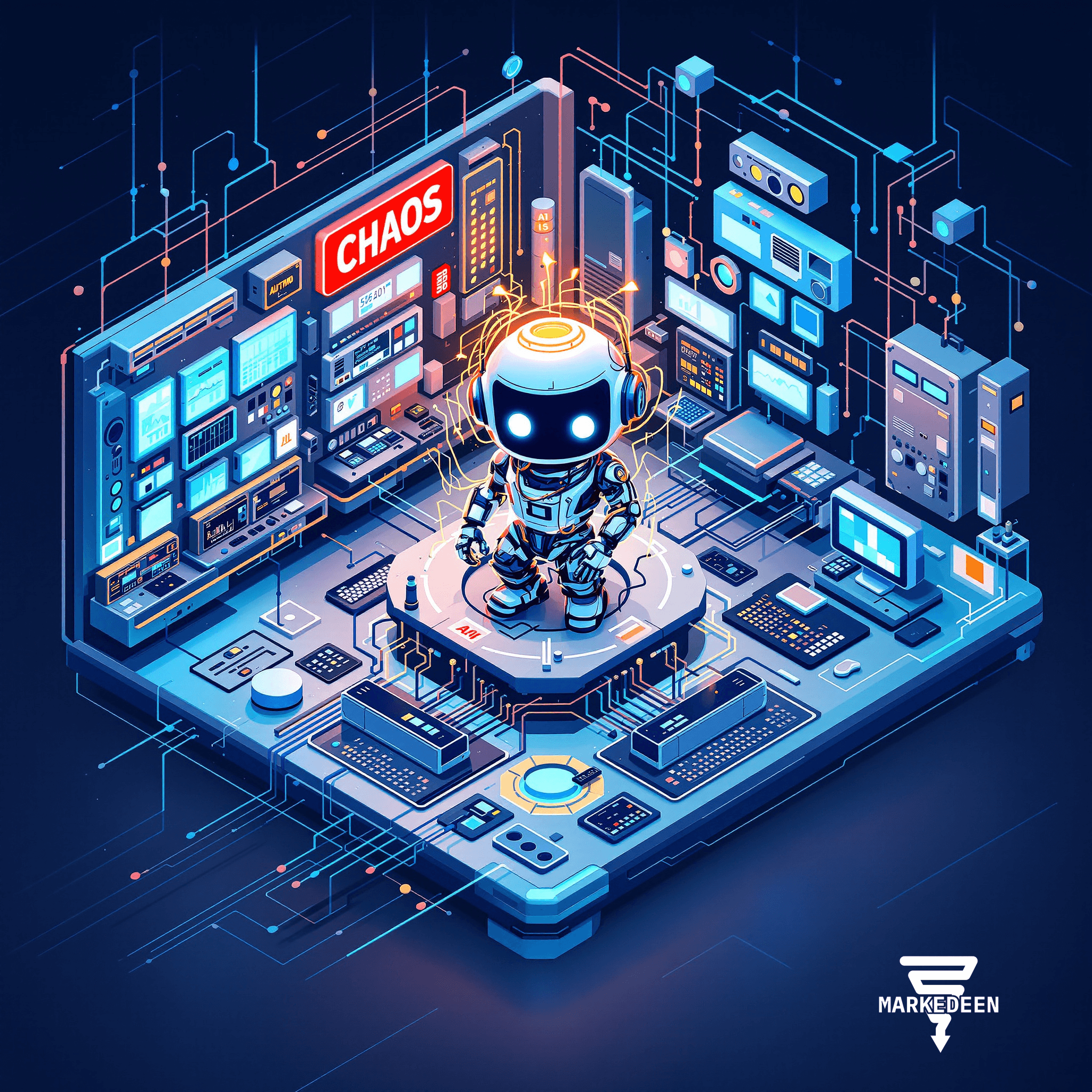
We've been watching something remarkable unfold over the past few weeks. Companies are discovering they can step back from operations entirely and govern their businesses the way a board governs a corporation (setting goals, approving major decisions, reviewing outcomes) while autonomous systems handle everything in between.
This isn't about replacing a spreadsheet with a chatbot. It's about fundamentally restructuring how work gets done.
The Orchestration Problem Nobody Talked About
For months, businesses have been experimenting with AI agents. The results were promising but chaotic. You'd spin up five different automation sessions, each tackling a piece of a project. By day's end, you'd have twenty terminal windows open, no clear view of what was happening where, and zero coordination between systems.
The underlying capability was there. The orchestration layer wasn't.
What's emerged is a new category of business infrastructure: systems that don't just execute tasks, but manage entire operational units. They understand company structure, coordinate between functions, maintain institutional memory, and operate continuously without human oversight.
How Board-Level Operations Actually Work
The model is deceptively simple. You define your business at a strategic level, mission, initial structure, high-level goals. Then you step back.
The system builds out from there. A CEO-level agent assesses what capabilities are needed and provisions them. Need engineering? It specs and instantiates an engineering function with the right configuration and access. Need QA? Same process. Each function understands its role, has access to appropriate tools, and coordinates with other functions through a shared context.
You interact through a ticketing system. Create an issue, assign it to the relevant function, set the context. The system breaks it down, routes work appropriately, executes, and flags anything requiring board-level approval.
Meanwhile, everything runs on heartbeats. Functions wake up on schedule (every four, eight, or twelve hours) review their context, check their tasks, and continue work. They don't wait for you to remember to prompt them. They don't lose thread when you close a window. They operate continuously, transparently, with full audit trails.
The Implications Are Structural
This changes the founder's job description. You're no longer in the weeds managing tasks and coordinating handoffs. You're setting strategy, making capital allocation decisions (including compute budgets per function), and approving major initiatives.
It changes how you scale. Instead of hiring tactically to fill immediate gaps, you architect capability. Need a content operation? Stand up a marketing function with copywriting, strategy, design, and research sub-functions. Need to launch a new product vertical? Spin up a complete unit with engineering, QA, and release management.
It changes your cost structure. Traditional scaling meant linear cost growth, more people, more overhead, more coordination tax. This model inverts that. Core operations run on compute. You pay for tokens and cycles, not salaries and benefits. And you can dial spend up or down per function based on business priorities.
The Architecture Underneath
What makes this possible is a convergence of capabilities that didn't exist six months ago.
First, execution environments sophisticated enough to handle real work, terminal access, file systems, API calls, web research, code generation. Second, context windows large enough to maintain coherent strategy across extended work sessions. Third, structured memory systems that let agents maintain institutional knowledge and coordinate effectively.
The orchestration layer ties it together. It provides the routing fabric between functions, the approval workflow for governance, the heartbeat scheduler for continuous operation, and the audit trail for visibility.
You can run this entirely locally or deploy it to remote infrastructure for anywhere-access. You can integrate existing automation work (custom agents, specialized workflows) into the broader operational structure. You can even import pre-built company templates: entire organizational units with configured roles, established processes, and domain knowledge.
What We're Building With This
At Markedeen, we've begun deploying this model selectively. Not wholesale replacement of existing operations, but strategic augmentation. A content unit here. A research function there. Proving the model, learning the patterns, understanding where it creates asymmetric leverage.
The goal isn't to eliminate human work. It's to eliminate coordination overhead and free humans to operate at the level where they create the most value.
For founders, that means strategy, taste, and relationships. For operators, it means exception handling and high-judgment decisions. For specialists, it means the creative and analytical work that actually moves the needle.
The New Operating Leverage
The practical implications are striking. A technical founder can run a complete software product operation (engineering, QA, deployment) without building a team. A content business can scale production by 10x without linear cost growth. A services firm can systematize delivery without sacrificing customization.
The constraint shifts from coordination capacity to strategic clarity. If you can articulate what success looks like, the system can figure out how to get there. If you can't, no amount of automation will help.
This puts a premium on different skills. Clear goal-setting. Effective governance. Quality evaluation. These become the core competencies of the modern operator.
Getting Started Is Simpler Than You Think
The barrier to entry is remarkably low. The core infrastructure is open-source. You can have a basic operation running in under an hour. The learning curve is real but manageable, especially if you use an AI project assistant to help you configure and optimize as you go.
Start small. Pick one operational area where you're currently drowning in coordination overhead. Stand it up as an autonomous function. Learn the patterns. Then expand.
The businesses that figure this out first will have an extraordinary advantage. Not because they're using AI, everyone will be doing that. But because they've restructured their operations around a fundamentally more scalable model.
If you're exploring how orchestrated AI operations could transform your business model, we'd welcome the conversation. This is precisely the kind of systems-level transformation we help companies architect and implement.
More on Strategy
Want a system like this in your business?
We build the automation behind everything you just read.